What Are AI Agent Platforms and Why They Matter
AI agent platforms are tools that let you build software agents — autonomous programs powered by large language models (LLMs) that can reason about tasks, make decisions, use tools, and execute multi-step workflows without constant human supervision. Unlike traditional automation that follows rigid if-then rules, AI agents interpret goals, plan approaches, adapt to unexpected situations, and learn from feedback. If that distinction is new, our explainer on what automation is and the AI automation guide put these platforms in context.
From Chatbots to Autonomous Agents
The progression from chatbots to AI agents represents a fundamental capability leap. Chatbots respond to individual prompts — you ask a question, they answer. AI agents take on goals and work toward them independently. Tell an AI agent "Monitor competitor prices daily and alert me when any product drops below our price," and it will figure out which sites to check, how to extract prices, where to store the data, how to compare prices, and when to send alerts. It reasons through the problem rather than following a pre-programmed script.
This distinction matters because most valuable business tasks are not single-step prompts — they are multi-step processes that require judgment, tool usage, and adaptation. Updating a CRM based on email content, researching competitors across multiple websites, generating reports from scattered data sources, or processing documents with variable formats all require the kind of goal-oriented reasoning that agents provide.
The Core Architecture of AI Agents
AI agent platforms share a common architecture, regardless of their specific implementation:
- LLM backbone: The reasoning engine that interprets tasks, plans steps, and makes decisions. Most platforms use GPT-4, Claude, or open-source models like Llama.
- Tool access: Agents need to interact with the real world — browsing websites, querying APIs, reading files, writing data, sending emails. Each platform provides a different set of tools the agent can use.
- Memory: Agents maintain context across actions. Short-term memory holds the current task state. Long-term memory stores learned patterns, past results, and user preferences.
- Planning loop: The agent evaluates its current state, decides the next action, executes it, observes the result, and repeats until the goal is achieved or a stopping condition is met.
- Guardrails: Safety constraints that prevent the agent from taking harmful actions, spending excessive resources, or operating outside defined boundaries.
Why AI Agents Are Relevant Now
Several developments in the past 18 months have made AI agents practically useful for business automation:
- Improved reasoning: LLMs like GPT-4o, Claude 3.5 Sonnet, and Gemini can now reliably plan multi-step tasks, recover from errors, and make reasonable decisions when faced with ambiguous situations.
- Reliable tool use: Modern LLMs generate structured tool calls (function calling) with high accuracy, enabling agents to interact with APIs, browsers, and databases reliably.
- Context window expansion: With context windows exceeding 100K tokens, agents can reason about large datasets, long documents, and complex multi-step histories without losing track of earlier information.
- Cost reduction: LLM costs have dropped dramatically, making agent loops (which may involve dozens of LLM calls per task) economically feasible for business automation.
Autonoly: AI Agents with Browser Automation and Visual Workflows
Autonoly combines AI agent capabilities with browser automation and a visual workflow builder, creating a platform where agents can interact with any website or web application as part of larger automated workflows.
What Makes Autonoly Different
Most AI agent platforms operate in a text and API world — they can call APIs, process text, and generate content, but they cannot interact with websites that do not have APIs. Autonoly's agents operate a real browser (Chromium via Playwright), which means they can navigate websites, fill out forms, click buttons, extract data from rendered pages, handle CAPTCHAs, and interact with web applications just as a human would.
This browser capability is a significant differentiator because the vast majority of business tools, data sources, and processes involve web-based interfaces. A recruiting agent that needs to search LinkedIn, an e-commerce agent that needs to monitor competitor prices on Amazon, or an operations agent that needs to enter data into a legacy web portal all require browser interaction that text-only agent platforms cannot provide.
Key Features
- Visual workflow builder: Build multi-step agent workflows on a drag-and-drop canvas. Chain browser actions, data transformations, API calls, and integrations (Google Sheets, Slack, email) into automated pipelines.
- Natural language task description: Describe tasks in plain English. The agent interprets your goal, plans the approach, and executes the steps. "Go to Amazon, search for wireless headphones, and extract the top 50 results with prices and ratings."
- Anti-detection: Built-in proxy rotation, browser fingerprint management, and CAPTCHA handling. The agent adapts its behavior when encountering anti-bot measures.
- Scheduled execution: Run agent workflows on daily, weekly, or custom schedules for automated monitoring and data collection.
- Multi-step reasoning: Agents plan approaches, handle pagination, recover from errors, and adapt to unexpected page layouts without explicit programming for each scenario.
Strengths
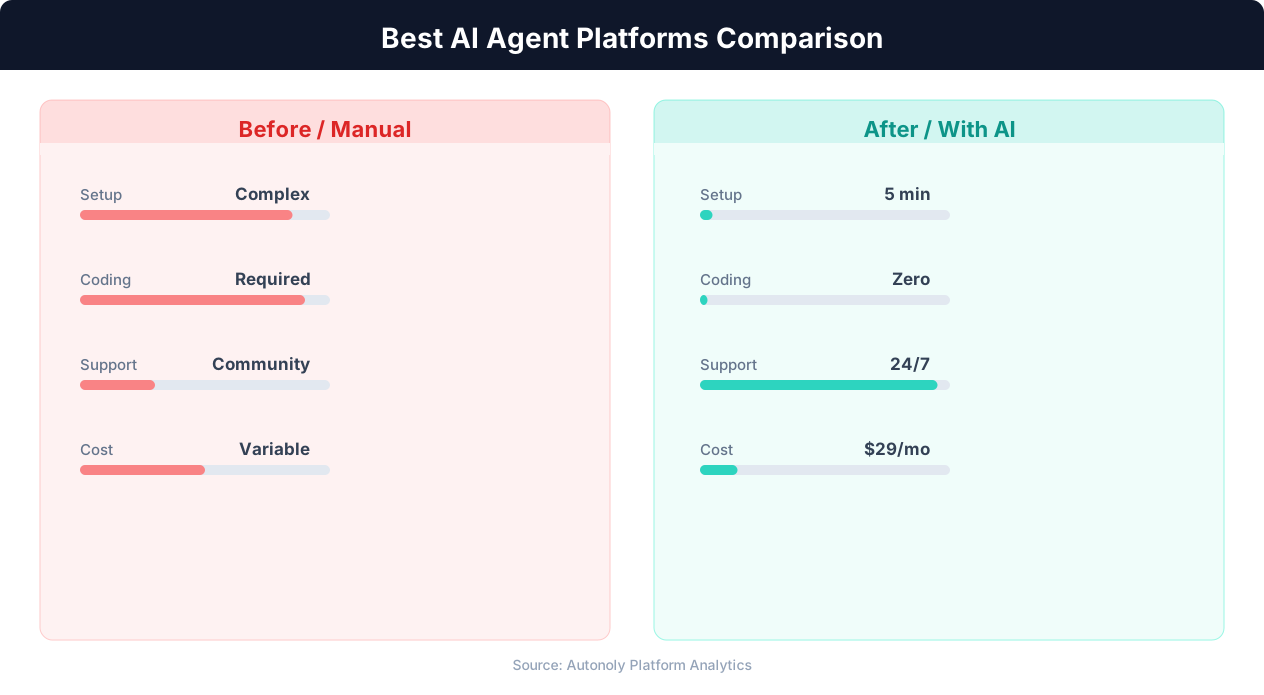
Autonoly's primary strength is making AI agents accessible to non-technical users. The combination of natural language task description and visual workflow building means you do not need to understand LLM prompting, API integration, or browser automation to build powerful agent workflows. The platform handles the technical implementation while you focus on the business logic.
The browser automation capability makes Autonoly uniquely suited for tasks that involve interacting with the real web — scraping, form filling, data monitoring, and cross-platform workflow automation.
Limitations
Autonoly is focused on web-based automation. Tasks that primarily involve local file processing, code generation, or purely conversational AI are better served by other platforms. The agent's browser-based approach is also slower than direct API calls — each browser interaction takes seconds rather than milliseconds — making it less suitable for high-frequency, low-latency tasks.
Best For
Non-technical teams that need AI agents to automate web-based workflows: data scraping, price monitoring, form automation, cross-system data entry, and automated reporting.
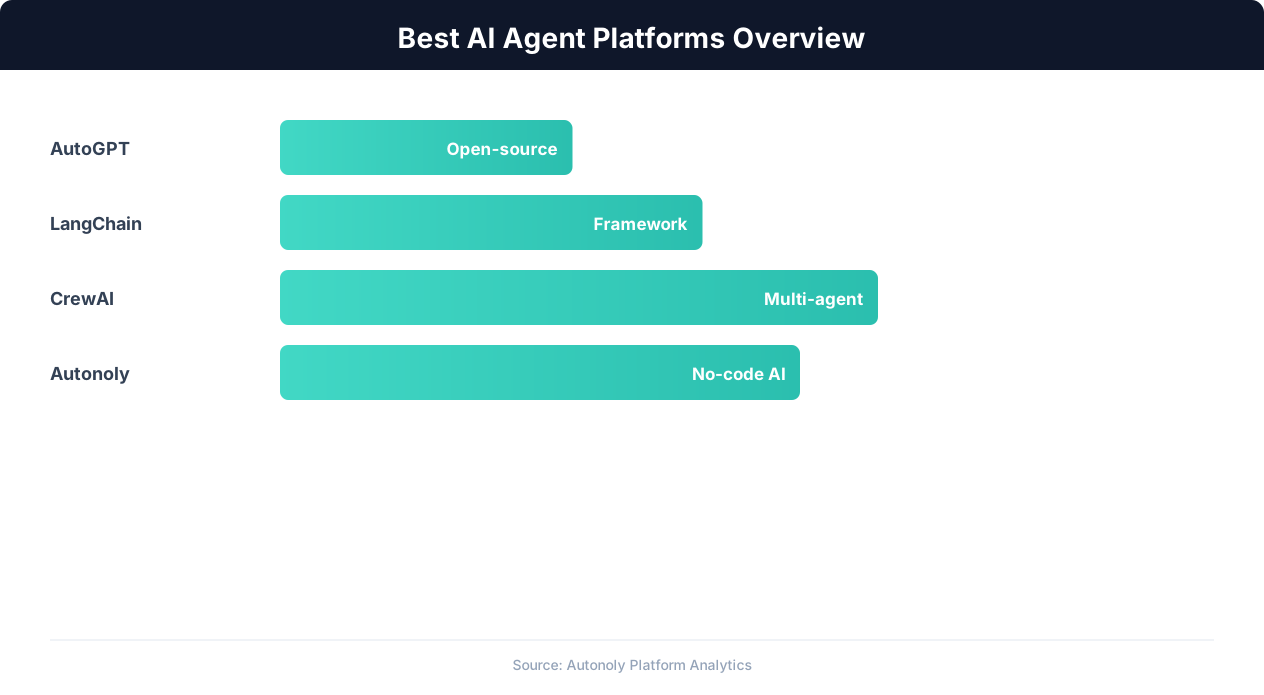
AutoGPT and CrewAI: Open-Source Agent Frameworks
AutoGPT and CrewAI represent the open-source side of the AI agent ecosystem. Both are frameworks that developers use to build custom agent applications, offering flexibility and control at the cost of requiring significant technical expertise.
AutoGPT
AutoGPT was one of the first autonomous AI agent projects, launched in early 2023. It demonstrated the concept of an AI agent that could plan and execute multi-step tasks by chaining LLM calls with tool usage. The agent receives a goal, breaks it into sub-tasks, executes each sub-task using available tools (web search, file I/O, code execution), and iterates until the goal is achieved.
Key features: Self-prompting agent loop, web browsing (via Selenium), file read/write, code execution, plugin system for extending capabilities, and memory management with vector databases.
Strengths: As one of the most well-known AI agent projects (40,000+ GitHub stars), AutoGPT has extensive community resources, tutorials, and plugins. The open-source nature means full customization — you can modify the agent's behavior, add custom tools, and run it on your own infrastructure. Recent versions include a web-based UI and marketplace for agent templates.
Limitations: AutoGPT's autonomous loop can be unpredictable and expensive. Without careful guardrails, the agent may spend dozens of LLM calls on tangential sub-tasks, run up API costs, or get stuck in reasoning loops. The web browsing capability (built on Selenium) is less reliable than Playwright-based alternatives and lacks sophisticated anti-detection. Setting up and configuring AutoGPT requires Python development skills and understanding of LLM prompt engineering.
Best for: Developers and researchers who want a customizable open-source agent framework for experimentation and custom agent development. Not recommended for production business automation without significant engineering investment.
CrewAI
CrewAI takes a different approach: instead of a single agent, it orchestrates multiple specialized agents that collaborate on tasks. Each agent has a defined role ("researcher," "writer," "analyst"), specific tools, and a backstory that shapes its behavior. Tasks are assigned to the most appropriate agent, and agents can delegate sub-tasks to each other.
Key features: Multi-agent orchestration, role-based agent definition, task delegation between agents, integration with LangChain tools, support for multiple LLM providers, and hierarchical agent processes.
Strengths: The multi-agent paradigm maps naturally to business workflows where different functions contribute to a shared outcome. A "research agent" gathers data, an "analysis agent" processes it, and a "reporting agent" formats the output. This separation of concerns makes agent behavior more predictable than single-agent approaches because each agent has a focused responsibility.
Limitations: CrewAI requires Python development skills and understanding of LLM agent architecture. The multi-agent coordination adds complexity — debugging interactions between agents is harder than debugging a single agent. No built-in browser automation, web scraping, or visual workflow builder. Performance depends heavily on prompt engineering quality for each agent's role definition.
Best for: Developer teams building custom multi-agent applications where task decomposition and role specialization are important. Research teams exploring multi-agent collaboration patterns.
LangGraph and Relevance AI: Framework and Platform Approaches
LangGraph and Relevance AI represent two different points on the build-versus-buy spectrum. LangGraph is a developer framework for building sophisticated agent graphs, while Relevance AI is a managed platform that provides pre-built agent capabilities with a visual interface.
LangGraph
LangGraph, developed by LangChain, is a framework for building stateful, multi-actor agent applications as directed graphs. Each node in the graph represents an agent action, an LLM call, or a tool execution, and edges define the flow between nodes based on conditions and state transitions.
Key features: Graph-based agent workflow definition, persistent state management across turns, conditional branching and cycles (agents can revisit previous steps), streaming support for real-time output, human-in-the-loop checkpoints, and integration with the LangChain ecosystem.
Strengths: LangGraph provides the most fine-grained control over agent behavior of any platform we evaluated. The graph-based model lets you define exactly how the agent reasons, when it uses tools, what happens when errors occur, and where human approval is required. For complex agent workflows with specific reliability and safety requirements, LangGraph's explicit control is invaluable.
The LangChain ecosystem provides access to hundreds of pre-built tool integrations, document loaders, and LLM providers. If you are already using LangChain for other AI projects, LangGraph is a natural extension.
💡 Key Insight
The AI agent platform market is projected to reach $47 billion by 2030, growing at 44.8% CAGR.
Limitations: LangGraph requires strong Python development skills and understanding of graph-based programming, state machines, and LLM agent architecture. The learning curve is steep even for experienced developers. There is no visual builder or natural language interface — everything is defined in code. Production deployment requires infrastructure management (LangGraph Cloud is available but adds cost).
Best for: Advanced AI engineering teams building production-grade agent applications that require precise control over agent behavior, state management, and reliability guarantees.
Relevance AI
Relevance AI is a managed platform that provides a visual interface for building AI agent workflows. It positions itself between pure code frameworks (LangGraph, CrewAI) and fully autonomous agents (AutoGPT), offering structured agent workflows with visual configuration.
Key features: Visual workflow builder for agent chains, pre-built tools (web search, data extraction, content generation), multi-step agent workflows with conditional logic, API and webhook integrations, team collaboration features, and managed execution infrastructure.
Strengths: Relevance AI provides a reasonable balance between ease of use and flexibility. The visual builder makes agent workflows accessible to non-technical users while still supporting custom tool integration and conditional logic. The managed infrastructure eliminates the need to host and scale your own agent execution environment.
Limitations: Relevance AI's agent capabilities are more structured and less autonomous than true agent platforms. The workflows are closer to enhanced automation (with LLM-powered decision nodes) than fully autonomous agents. Browser automation is limited compared to Autonoly's Playwright-based approach. The platform is still maturing, with fewer integrations and a smaller community than established alternatives.
Best for: Teams that want AI-enhanced automation with more flexibility than traditional no-code tools but less complexity than developer-focused agent frameworks. Good for internal business automation where visual workflow building and managed infrastructure are priorities.
Feature Comparison Matrix
Comparing AI agent platforms is challenging because they serve different audiences and optimize for different capabilities. This comparison matrix highlights the most important differentiators across all six platforms.
Core Capabilities
| Feature | Autonoly | AutoGPT | CrewAI | LangGraph | Relevance AI |
|---|---|---|---|---|---|
| No-code interface | Yes (visual + NL) | Basic web UI | No (Python) | No (Python) | Yes (visual) |
| Browser automation | Full (Playwright) | Basic (Selenium) | No | No (manual) | Limited |
| Multi-agent | Single agent | Single agent | Yes (core feature) | Yes (graph nodes) | Single agent |
| Anti-detection | Built-in | Minimal | N/A | N/A | Minimal |
| Scheduling | Built-in | Manual setup | Manual setup | Via LangGraph Cloud | Built-in |
| Custom tools | Via workflow nodes | Plugin system | LangChain tools | LangChain tools | Custom API calls |
| Self-hosted option | No | Yes (OSS) | Yes (OSS) | Yes (OSS) | No |
User Experience
| Factor | Autonoly | AutoGPT | CrewAI | LangGraph | Relevance AI |
|---|---|---|---|---|---|
| Setup time (first workflow) | 15-30 min | 1-2 hours | 2-4 hours | 4-8 hours | 30-60 min |
| Learning curve | Low | Medium-High | High | Very High | Low-Medium |
| Target user | Business teams | Developers | AI engineers | Senior AI engineers | Business/technical |
| Documentation quality | Good | Community-maintained | Good | Excellent | Good |
💡 Key Insight
Top-performing AI agent platforms achieve 85%+ autonomous task completion rates on complex multi-step workflows.
Production Readiness
| Factor | Autonoly | AutoGPT | CrewAI | LangGraph | Relevance AI |
|---|---|---|---|---|---|
| Reliability for business use | High | Low-Medium | Medium | High (with effort) | Medium-High |
| Error handling | Built-in | Basic | Basic | Full control | Built-in |
| Cost predictability | Subscription | Variable (API costs) | Variable (API costs) | Variable (API costs) | Subscription |
| Monitoring/logging | Built-in dashboard | Console logs | LangSmith integration | LangSmith integration | Built-in dashboard |
The comparison reveals a clear spectrum: developer frameworks (LangGraph, CrewAI) offer maximum control but require significant technical investment. Open-source agents (AutoGPT) offer experimentation potential but limited production reliability. Managed platforms (Autonoly, Relevance AI) prioritize accessibility and reliability for business users. Your position on this spectrum should match your team's technical capabilities and your use case requirements.
How to Choose the Right AI Agent Platform
The right AI agent platform depends on three factors: your team's technical capabilities, your primary use case, and your production reliability requirements. Here is a decision framework that maps these factors to platform recommendations.
Decision by Technical Capability
Non-technical teams (no developers): Choose Autonoly or Relevance AI. Both provide visual interfaces and natural language task description. Autonoly is stronger for web-based automation (scraping, browser interaction, data extraction). Relevance AI is better for internal business workflows that primarily involve APIs and content generation.
Teams with Python developers: Consider CrewAI for multi-agent applications, or LangGraph for complex workflows requiring precise control. These frameworks provide maximum flexibility but require significant development investment. For web automation use cases, Autonoly may still be faster to deploy even with available development resources.
AI/ML engineering teams: LangGraph provides the most sophisticated agent architecture. Its graph-based model supports complex reasoning patterns, human-in-the-loop workflows, and fine-grained state management that other platforms cannot match. If you are building a production AI application (not just automating business tasks), LangGraph is the engineering-grade choice.
Decision by Use Case
Web scraping and data extraction: Autonoly is the clear winner. Its Playwright-based browser automation, built-in anti-detection, and AI-powered data extraction handle web scraping scenarios that other agent platforms cannot address. AutoGPT has basic web browsing, but it lacks the reliability and anti-detection capabilities needed for production scraping.
Multi-step business automation: Autonoly for web-based workflows, Relevance AI for API-based workflows. Both support scheduling, error handling, and integration with business tools. CrewAI is an option for teams comfortable with Python who need multi-agent collaboration.
Content generation and research: CrewAI excels here with its multi-agent approach — a researcher agent gathers information, a writer agent produces content, and an editor agent reviews it. AutoGPT is also capable for research tasks but less reliable in production.
Custom AI applications: LangGraph for maximum control and production reliability. CrewAI for multi-agent applications. These are developer tools for building AI products, not business automation tools.
Decision by Reliability Requirements
High reliability needed (customer-facing, business-critical): LangGraph with careful engineering, or Autonoly for web automation. Both provide the error handling, monitoring, and predictability needed for production workloads.
Moderate reliability (internal tools, non-critical automation): Any managed platform (Autonoly, Relevance AI) provides sufficient reliability for internal business automation.
Experimentation and prototyping: AutoGPT for exploring agent capabilities. CrewAI for prototyping multi-agent interactions. These open-source tools are best for learning and prototyping before committing to a production platform.
Cost Considerations
All AI agent platforms incur LLM API costs — each agent reasoning step requires an LLM call. A complex task with 20 reasoning steps using GPT-4o costs approximately $0.10-0.50 in API fees per execution. Managed platforms (Autonoly, Relevance AI) include infrastructure costs in their subscription. Self-hosted frameworks (AutoGPT, CrewAI, LangGraph) require you to manage infrastructure costs separately. Factor in the total cost of ownership — including development time, infrastructure management, and maintenance — not just the platform subscription or API costs.
Compare directly: Best Relevance AI alternatives · Best Lindy alternatives · Best Gumloop alternatives · Best Relay alternatives.