The Evolution of Web Scraping: From curl to AI Agents
Web scraping has gone through distinct technological generations, each making data extraction more accessible and more capable. Understanding this evolution explains why AI-powered scraping is not just an incremental improvement but a fundamental paradigm shift.
Generation 1: HTTP Libraries and Regex (Early 2000s)
The earliest web scrapers downloaded HTML with HTTP libraries (curl, wget, Python's urllib) and extracted data using regular expressions or string manipulation. This approach was fast and lightweight but incredibly brittle. A single change to the HTML formatting broke the extraction. Writing regex patterns to handle the messy, inconsistent HTML of real websites was an exercise in frustration. Only developers with strong programming skills could build and maintain these scrapers.
Generation 2: HTML Parsers and CSS Selectors (Late 2000s)
BeautifulSoup, lxml, and Jsoup made HTML parsing accessible by providing DOM traversal APIs that understood HTML structure. Instead of matching text patterns, you could navigate the document tree: find the third div inside the element with class "product-list" and extract its text. CSS selectors and XPath added powerful query languages for finding elements. This generation made scraping significantly more reliable and readable, but it still required programming skills and manual selector development. Scrapers still broke when websites changed their HTML structure.
Generation 3: Browser Automation (2010s)
Selenium, Puppeteer, and Playwright brought real browser engines to scraping. For the first time, scrapers could handle JavaScript-rendered content, interact with dynamic interfaces, fill forms, click buttons, and navigate single-page applications. This unlocked scraping of modern web applications that returned empty HTML shells without JavaScript execution. But the complexity increased: managing browser instances, handling race conditions, waiting for dynamic content, and consuming significantly more compute resources. Browser automation made more websites scrapable but raised the skill bar for building robust scrapers.
Generation 4: Scraping Frameworks and Services (Late 2010s)
Scrapy, Crawlee, and cloud scraping services (ScrapingBee, Bright Data's Web Scraper API) abstracted common challenges: proxy rotation, rate limiting, retry logic, anti-bot evasion, and scaling. These tools reduced the infrastructure burden but still required developers to define extraction logic: which pages to visit, which elements to extract, how to handle pagination and edge cases. The "what to extract" still required human specification through code.
Generation 5: AI-Powered Scraping (Now)
AI agents represent the fifth generation. Instead of writing code that specifies exactly which HTML elements to extract, you describe what data you want in natural language. The AI agent navigates to the website, understands the page visually and structurally, identifies the relevant data, extracts it, and structures it according to your needs. The agent handles page interactions, pagination, dynamic content, and layout variations without explicit instructions for each scenario.
This is not a marginal improvement over Generation 4. It is a category change. Previous generations made scraping faster, more reliable, or more scalable, but all of them required a human to specify the extraction logic in code or configuration. AI-powered scraping removes that requirement entirely. The user specifies the outcome ("I want product names, prices, and ratings from this page"), and the AI handles the implementation. This shift from specifying "how" to specifying "what" makes web scraping accessible to anyone who can describe the data they need.
How AI-Powered Web Scraping Works Under the Hood
AI-powered scraping combines large language models (LLMs) for understanding and decision-making with browser automation for page interaction. Here is what happens under the hood when an AI agent scrapes data for you.
Page Understanding
When an AI agent navigates to a web page, it builds an understanding of the page through multiple channels. First, it reads the DOM (Document Object Model), the HTML structure of the page, which provides the raw content, element hierarchy, and relationships between elements. Second, many AI agents take screenshots and use vision capabilities to understand the visual layout: where elements are positioned, what they look like, and how they relate visually. This dual understanding (structural and visual) is more robust than either approach alone because it handles cases where the HTML structure is misleading or the visual layout does not match the DOM hierarchy.
The AI agent uses this page understanding to identify data elements without explicit selectors. When you say "extract product prices," the agent examines the page and identifies which elements contain prices based on their content (numbers with currency symbols), context (near product names and buy buttons), and visual presentation (prominently displayed, often larger or differently colored). It does not need a CSS selector like .product-price to find prices; it recognizes prices by their semantic characteristics.
Intelligent Navigation
Traditional scrapers follow predefined navigation paths: go to URL A, click button B, fill form C. If the path changes, the scraper breaks. AI agents navigate intelligently by understanding page purpose and interface patterns. When the agent needs to search for products, it identifies the search input (by its placeholder text, position, or associated label), enters the query, and submits the search, regardless of whether the search bar is in a header, a sidebar, or a modal.
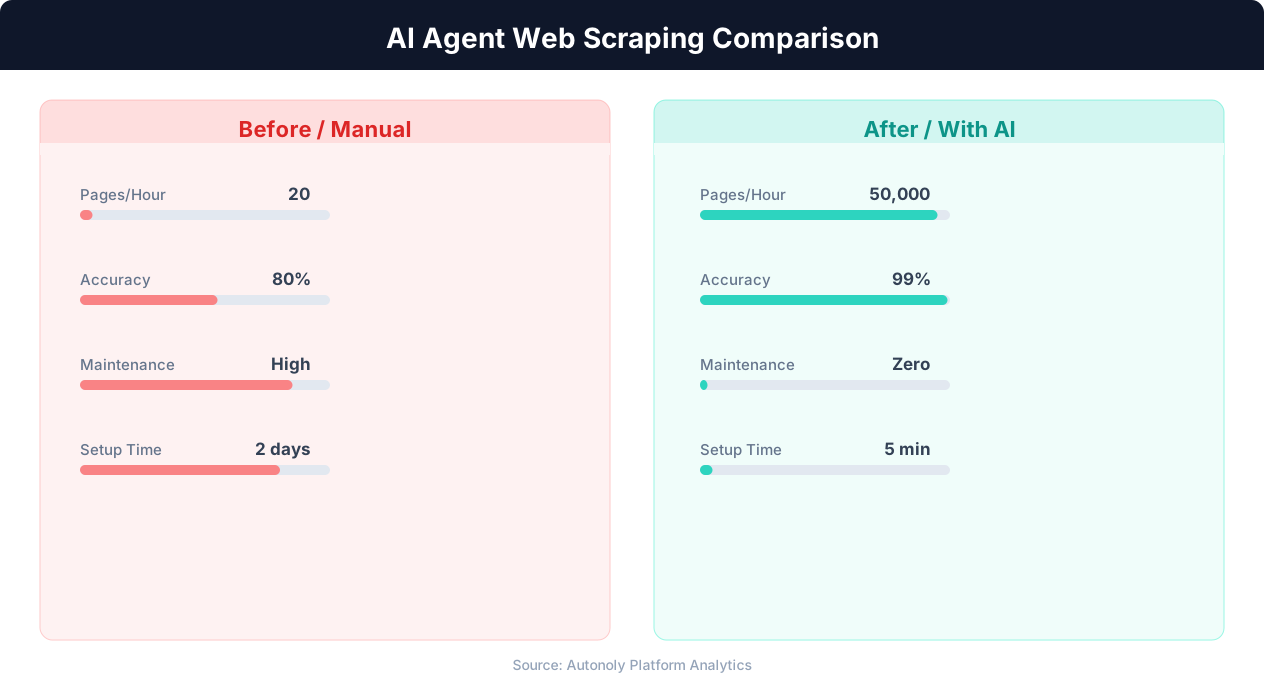
This intelligent navigation extends to complex interactions. An AI agent can: handle cookie consent banners (recognizing the popup and clicking the appropriate button), navigate multi-step checkout processes, interact with dropdown menus and filters, handle pagination by recognizing "Next" buttons or page number links, and deal with infinite scroll by scrolling and detecting when new content loads. Each of these interactions would require explicit code in a traditional scraper but emerges naturally from the AI's understanding of web interfaces.
Adaptive Extraction
Perhaps the most powerful aspect of AI-powered scraping is adaptive extraction. When the agent visits ten different product pages on ten different e-commerce sites, each with a completely different HTML structure, CSS classes, and layout, it extracts the same data (product name, price, description, image URL) from all of them. It adapts its extraction approach to each page's specific structure, using the semantic meaning of the content rather than site-specific selectors.
This adaptability means a single instruction ("extract product details from this page") works across hundreds of different websites without per-site configuration. Traditional scraping requires writing and maintaining separate extraction logic for each target website. AI scraping requires only one description that works everywhere because the AI generalizes across different presentations of the same underlying data.
Error Recovery
Traditional scrapers crash or produce empty data when they encounter unexpected page states: a modal obscuring the content, a CAPTCHA challenge, a different page layout for logged-in vs. logged-out users, or a server error page. AI agents handle these situations through reasoning. If a modal appears, the agent recognizes it as an obstacle and closes it. If the page looks different than expected, the agent reassesses and adapts its approach. If an error page appears, the agent can retry or navigate to an alternative path. This error recovery is not hard-coded for specific error types; it emerges from the agent's general ability to interpret and respond to unexpected situations.
AI Scraping vs. Traditional Scraping: When to Use Each
AI-powered scraping is not universally superior to traditional approaches. Each has strengths that make it better suited for specific scenarios. Understanding the tradeoffs helps you choose the right approach for each project.
Where AI Scraping Excels
Multi-site extraction: When you need the same data from many different websites (product prices across 20 competitors, job listings from 10 job boards, contact information from 50 company websites), AI scraping shines. One description handles all sites. Traditional scraping requires writing separate code for each site.
Unfamiliar or complex sites: When you do not know the target site's structure in advance, or the site uses complex dynamic interfaces, AI agents figure out the navigation and extraction approach through exploration. Traditional scraping requires manual analysis of the site structure before writing any code.
Rapidly changing sites: Websites that frequently change their layout break traditional scrapers that depend on specific selectors. AI agents adapt to layout changes automatically because they understand content semantically rather than structurally. This makes AI scraping dramatically lower-maintenance for volatile targets.
Non-technical users: For people who need web data but cannot write code, AI scraping is the only option that works. Describing "get me the prices from this page" in plain English is accessible to anyone. Writing a BeautifulSoup script is not.
Where Traditional Scraping Excels
High-volume, single-site scraping: If you are scraping millions of pages from a single site with a consistent structure (like an entire product catalog from Amazon), a well-tuned traditional scraper is faster and more cost-effective. The AI's per-page reasoning overhead adds latency and token cost that matters at scale. A traditional scraper with optimized selectors processes pages in milliseconds; an AI agent processes them in seconds.
Structured API access: When the target site offers an API (official or discovered through network inspection), direct API calls are faster, more reliable, and cheaper than any browser-based approach. AI scraping is browser-based and inherits the overhead of rendering pages, even when the data is available through a simpler channel.
Extreme precision requirements: For scraping tasks where exact field mapping and zero tolerance for error are required (financial data extraction, regulatory compliance data), hand-coded scrapers with explicit validation rules provide more deterministic results. AI agents occasionally misinterpret page elements or include incorrect data, and the probabilistic nature of LLM reasoning means results can vary slightly between runs.
Cost-sensitive high-volume operations: AI scraping consumes LLM tokens for every page processed. At current pricing, processing a page through an AI agent costs $0.01-0.10 depending on page complexity and the model used. A traditional scraper processes the same page for fractions of a cent. For millions of pages, this cost difference is substantial.
The Hybrid Approach
The most effective teams use both approaches. They use AI scraping for exploration, prototyping, and multi-site extraction, then convert high-volume, stable scraping tasks to traditional code-based scrapers once the extraction logic is well-understood and the target site is stable. The AI agent discovers the right approach; the traditional scraper executes it at scale.
Platforms like Autonoly support this hybrid approach natively. The AI agent builds and tests the scraping workflow conversationally, producing a structured workflow that can be optimized and scheduled. The workflow runs efficiently on a schedule without requiring the AI agent's reasoning for each execution, combining the accessibility of AI scraping with the efficiency of automated workflows.
Practical Applications: AI Agent Scraping in Action
AI-powered scraping unlocks use cases that were previously impractical due to the development time and maintenance burden of traditional approaches. Here are applications where AI scraping creates the most value.
Competitive Intelligence Across Dozens of Sources
Monitoring your competitive landscape means tracking pricing pages, feature updates, blog content, job postings (as hiring signals), social media activity, and review site presence across all your competitors. For a company with 10 competitors, that is potentially 50-100 web sources to monitor, each with different layouts and structures. Building and maintaining traditional scrapers for all of them is a full-time engineering project. With AI scraping, you describe each monitoring task in natural language and the agent handles the variety. "Check competitor.com/pricing and extract their plan names, prices, and included features" works whether the pricing page is a simple table, a card layout, a comparison grid, or a custom design.
Market Research Data Collection
Market research often requires collecting data from sources that change with each project: industry association directories, conference speaker lists, patent databases, regulatory filings, trade publication archives, and company review sites. Each project targets different sources. Building traditional scrapers for one-time research projects is not economical because the development time exceeds the research value. AI scraping makes one-time data collection from unfamiliar sources practical because there is no development time; you describe what you need and the agent extracts it.
Lead Generation from Diverse Sources
B2B lead generation benefits enormously from AI scraping because the best leads come from diverse, unconventional sources that traditional scraping tools do not cover. Conference attendee lists published as PDFs on event websites. Speaking engagement lists that reveal thought leaders in a target industry. Award nominee lists that identify growing companies. Industry-specific directories with unique layouts. AI agents navigate and extract from all of these sources using the same conversational interface, building enriched prospect lists from sources your competitors have not automated.
Price Monitoring Across Heterogeneous Sites
E-commerce price monitoring is a well-established scraping application, but traditional approaches struggle with the diversity of site implementations. A product might be listed on Amazon (highly structured), a manufacturer's direct website (custom design), a niche e-commerce platform (unique layout), and marketplace aggregators (dynamic filtering interfaces). An AI agent extracts product prices and availability from all of these sites through a single consistent interface, adapting to each site's presentation automatically.
Real-Time Data Enrichment
When your workflow receives a company name and needs to enrich it with employee count, industry, headquarters location, and recent news, an AI agent can visit the company's website, extract the relevant information, and return structured data in seconds. Each company website has a different layout, but the AI understands what employee count and headquarters information look like regardless of how they are presented. Traditional enrichment approaches rely on third-party data providers that may have stale or incomplete data for smaller companies. AI scraping goes directly to the source.
Content Aggregation and Monitoring
Media monitoring, content curation, and trend analysis require extracting article titles, summaries, publication dates, and author information from hundreds of different news sites, blogs, and industry publications. Each publication has its own HTML structure and content layout. AI agents extract article metadata from any publication through semantic understanding: identifying the headline (the largest, most prominent text), the publication date (a date-formatted string near the top of the article), the author (a byline pattern), and the article body (the main text block). This enables content monitoring at a scale and breadth that would require a team of developers to maintain with traditional scrapers.
Building an AI-Powered Scraping Pipeline: Step by Step
Here is a practical guide to building a scraping pipeline powered by an AI agent, from initial setup through scheduled production execution.
Step 1: Define Your Data Requirements
Before engaging the AI agent, clearly define what data you need. Specify: the target websites or types of websites, the exact fields you want extracted (name, price, URL, description, rating, etc.), the output format and destination (Google Sheet, CSV, database), and the volume (how many pages or items). The clearer your requirements, the better the agent performs. Ambiguous requirements produce ambiguous results.
Step 2: Describe the Task to the AI Agent
Open your AI scraping platform (such as Autonoly) and describe the extraction task. Be specific about the data fields and output format. For example: "Go to [URL], find all product listings on the page. For each product, extract the product name, price, star rating, number of reviews, and product page URL. Output the results to a Google Sheet with one row per product."
If the task involves navigation (searching, filtering, pagination), describe the navigation requirements: "Search for 'wireless headphones' and sort by price low to high. Extract products from the first 5 pages of results."
Step 3: Watch the Agent Explore
The AI agent navigates to the target site and begins exploring. Watch the live browser view as it: loads the page and analyzes its structure, identifies the elements matching your data requirements, extracts data from the first few items as a test, and handles any navigation needed (clicking through pages, scrolling, applying filters). If the agent misidentifies an element or extracts the wrong data, provide guidance in real time through the chat interface.
💡 Key Insight
AI-powered web scraping achieves 95%+ accuracy on dynamic websites, compared to 60-70% for traditional rule-based scrapers.
Step 4: Validate Initial Results
After the agent completes its initial extraction, review the results carefully. Check: are all requested fields present and correctly populated? Is the data accurate (compare a sample against the actual website)? Are there any missing items or duplicates? Is the formatting correct? If issues exist, describe them to the agent: "The price field is including the currency symbol; please remove it" or "You are extracting the discounted price, but I also need the original price."
Step 5: Scale and Handle Edge Cases
Once the initial extraction is correct, expand to the full scope. If you need data from multiple pages, test pagination handling. If you need data from multiple sites, test each site individually. Common edge cases to test: pages with missing fields (some products might not have ratings), differently structured pages within the same site (sale items vs. regular items), and error pages or unavailable content.
Step 6: Build the Reusable Workflow
Once the extraction works correctly across your target scope, save it as a reusable workflow. The workflow captures the navigation steps, extraction logic, and output configuration, allowing it to run independently of the AI agent's real-time reasoning. This workflow is the production artifact: it runs on a schedule, handles retries, and produces consistent results.
Step 7: Schedule and Monitor
Set the workflow to run on your desired schedule (daily, weekly, etc.). Configure monitoring: set up alerts for workflow failures, output validation checks (ensure the result set size is within expected range), and data quality checks (no empty required fields). Review the first 3-5 scheduled runs to confirm everything works as expected, then move to periodic monitoring.
Step 8: Iterate and Expand
As your data needs evolve, modify the workflow conversationally. "Add a column for the product brand" or "Also extract from these three additional competitor sites." The AI agent modifies the existing workflow rather than building from scratch, preserving the validated extraction logic while adding new capabilities.
Limitations and Honest Considerations for AI Scraping
AI-powered scraping is powerful but not perfect. Understanding its limitations helps you set appropriate expectations and design systems that account for these constraints.
Cost at Scale
AI scraping consumes LLM tokens for understanding and reasoning about each page. For a complex page, this might be 5,000-20,000 tokens per page processed. At current pricing (roughly $3-15 per million tokens depending on the model), processing 10,000 pages costs $15-300 in LLM inference alone. For large-scale scraping, this cost can exceed what traditional scraping approaches cost in compute resources. The economics favor AI scraping for low-volume, high-variety tasks and traditional scraping for high-volume, low-variety tasks.
Speed
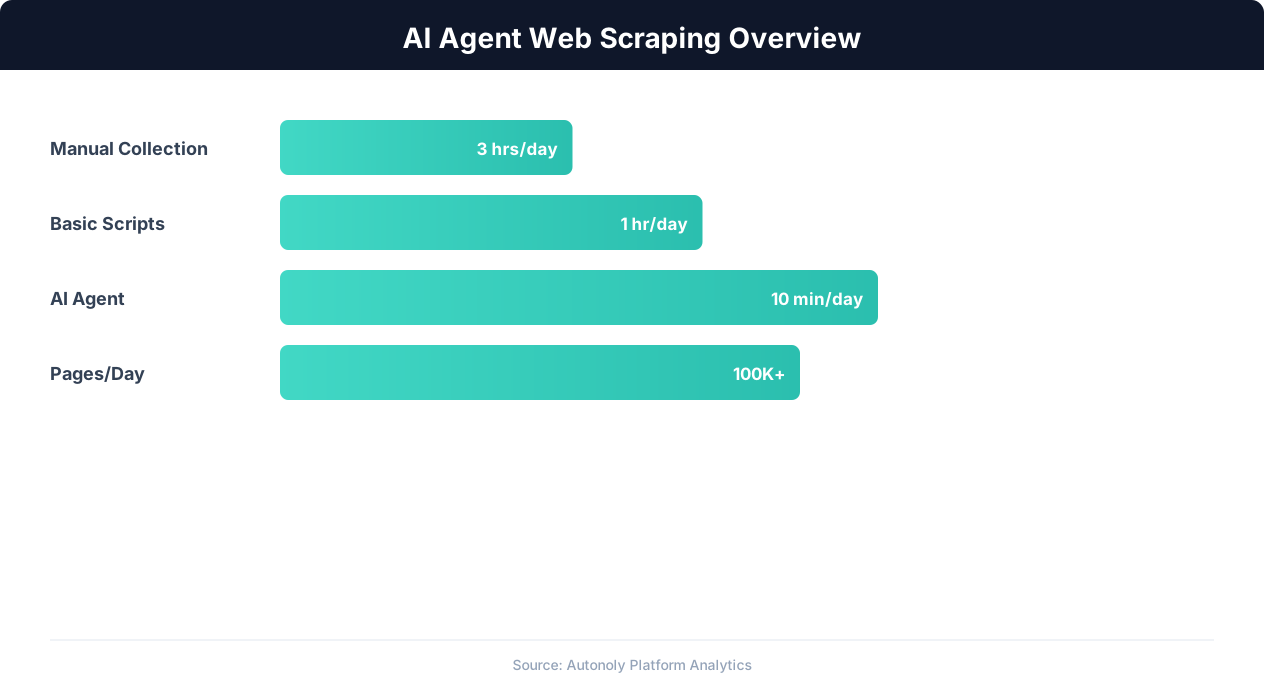
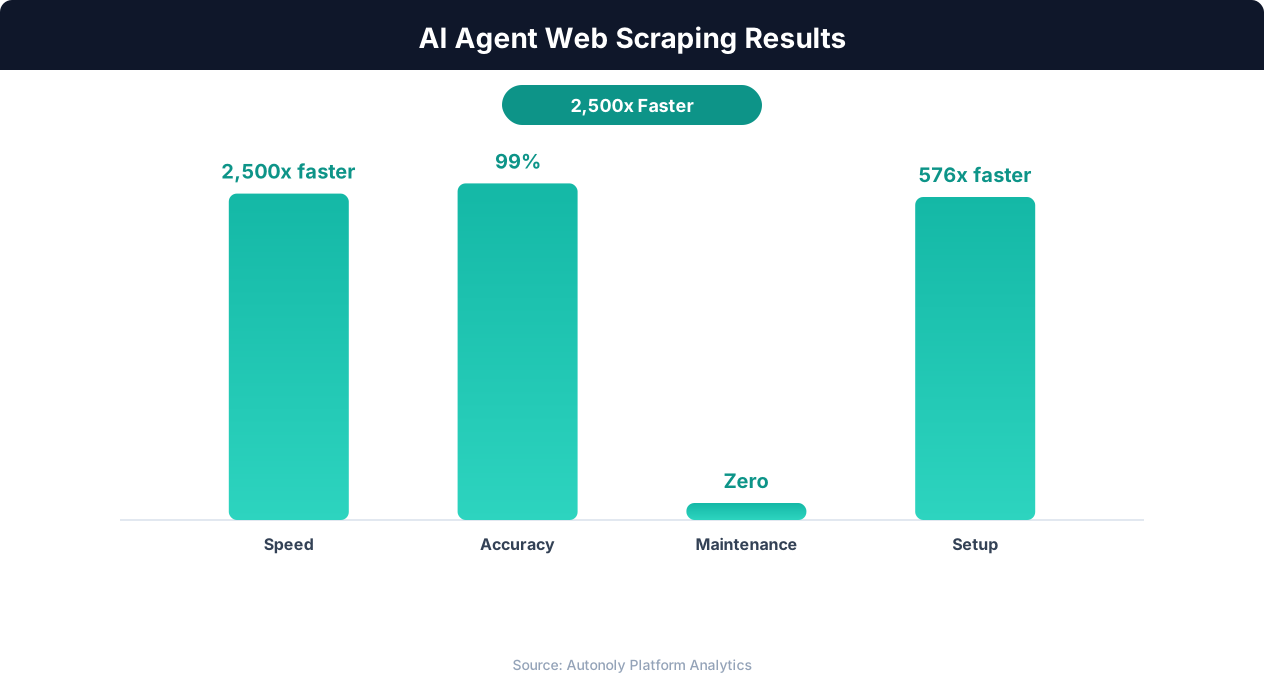
AI agents process pages slower than optimized traditional scrapers. The AI reasoning step adds 2-10 seconds per page on top of the browser rendering time. A traditional scraper with direct HTTP requests can process 10-50 pages per second. An AI agent processes 1-5 pages per minute. For time-sensitive applications (real-time price monitoring, flash sale detection), this speed difference matters. For daily or weekly data collection, it is usually acceptable.
Determinism
LLMs are probabilistic, meaning the AI agent might extract data slightly differently on different runs. A product name might be extracted as "Sony WH-1000XM5" on one run and "Sony WH-1000XM5 Wireless Noise-Canceling Headphones" on another, depending on how the agent interprets the extraction boundary. For applications requiring exact field-level consistency across runs, traditional scrapers with explicit selectors provide more deterministic results.
💡 Key Insight
Organizations using AI agents for web scraping report 5x faster data collection with 40% fewer maintenance hours.
Anti-Bot Detection
AI agents use real browsers, which helps with bot detection, but the browsing patterns of an AI agent may still be detectable. AI agents tend to navigate directly to target content (not browsing around first), interact with elements in a systematic rather than casual order, and process pages at a consistent pace. Advanced bot detection systems may flag these patterns. The anti-bot evasion techniques described in our anti-bot detection guide apply to AI-powered scraping as well.
Complex Data Relationships
AI agents handle flat data extraction well (extracting a list of items with attributes from a single page). They are less reliable at maintaining complex data relationships across pages: linking a product to its reviews, a company to its employees, or a news article to its comments when these data elements are on different pages. Complex relational extraction still benefits from explicit workflow design rather than pure conversational instruction.
Responsible Use
The accessibility of AI scraping lowers the barrier for everyone, including those who might use it irresponsibly. The same principles of responsible scraping apply regardless of the tool: respect robots.txt directives, maintain reasonable request rates, comply with data protection regulations, and do not scrape for purposes that are illegal or harmful. The ease of AI scraping does not change the ethical and legal framework within which scraping should occur. Being technically simple does not make irresponsible scraping acceptable.
These limitations are real but manageable. For the majority of web scraping use cases (collecting data from a moderate number of pages across diverse websites for business intelligence, market research, or operational automation), AI-powered scraping delivers superior results with dramatically less development effort than traditional approaches. The key is matching the approach to the use case rather than treating any single approach as universally optimal.
The Future: Where AI-Powered Scraping Is Heading
AI-powered scraping is in its early stages. Current capabilities represent the foundation for a much more powerful future. Here is where the technology is heading.
Structured Data APIs from AI Extraction
Today, AI scraping produces data as spreadsheets or data files. Tomorrow, AI scraping will produce live data APIs. Point the AI at a website, describe the data you want, and get back a structured API endpoint that returns fresh data from that site whenever you query it. This transforms any website into a queryable data source, blurring the line between web scraping and data integration.
Self-Maintaining Scrapers
Current AI scrapers can adapt to website changes in real time during a scraping session, but they do not automatically update scheduled workflows when a target site changes between runs. Future AI scrapers will detect when a scheduled run fails due to a site change, automatically re-explore the site to understand the change, update the extraction logic, and resume the scheduled run, all without human intervention. This self-maintenance eliminates the ongoing operational burden that makes traditional scraping expensive to sustain.
Cross-Page Understanding
Current AI agents are strongest at single-page extraction. Future agents will maintain understanding across page boundaries: following a product link to its detail page and extracting additional fields, navigating a company's entire website to compile a comprehensive profile, or following a thread across multiple pages to extract a complete dataset. This multi-page coherent extraction will enable much richer data collection without explicit navigation instructions.
Natural Language Data Queries
Future AI scraping interfaces will support natural language queries against previously scraped data. "What was the average price of wireless headphones on Amazon last Tuesday?" or "Which competitor changed their pricing most frequently this month?" These queries will run against your scraped data store, combining the AI's language understanding with the structured data your scraping pipeline has accumulated.
Collaborative Scraping Intelligence
As AI scraping platforms accumulate experience across many users scraping many sites, the collective intelligence improves. If one thousand users have successfully scraped Amazon product data, the platform learns the most reliable extraction patterns, the most effective navigation strategies, and the most common failure modes for Amazon. This cross-session learning means the platform gets better at scraping each site over time, benefiting all users.
The trajectory points toward a future where web data is as accessible as database data. Instead of building specialized infrastructure to extract information from websites, you will simply ask for the data you need, and the AI handles everything from navigation to extraction to structuring. The technical barrier between "I need this data" and "I have this data" disappears. What remains is the judgment about what data to collect, how to use it, and how to do so responsibly, which is exactly the kind of thinking humans should focus on while AI handles the mechanical extraction.