Why Scrape Instagram Data for Lead Generation?
Instagram has over 2 billion monthly active users and has become the primary marketing platform for businesses across industries from fashion and food to B2B services and real estate. The platform's public profiles contain a wealth of data that is directly useful for sales prospecting, influencer marketing, competitor analysis, and market research.
Instagram as a Business Intelligence Source
Unlike traditional business directories, Instagram provides real-time signals about a business or individual's activity, reach, and engagement. A business's Instagram profile reveals not just who they are, but how active they are, how their audience responds, and what content resonates with their followers. For sales and marketing teams, these signals are invaluable for identifying, qualifying, and prioritizing prospects.
Consider what a single Instagram business profile tells you: the business name, bio description (often containing email and phone), website URL, follower count, following count, post count, content themes, posting frequency, engagement rates, and hashtag usage. This is more dynamic and revealing than a static business directory listing.
Key Use Cases for Instagram Data
Instagram data extraction powers several high-value business workflows:
- Influencer marketing: Identify influencers in your niche by scraping profiles that match specific criteria (follower range, engagement rate, content theme, location). Build a database of potential influencer partners with verified engagement metrics rather than relying on self-reported numbers.
- Lead generation for agencies: Marketing agencies scrape Instagram business profiles to find potential clients. Businesses with large followings but low engagement rates need help with their content strategy. Businesses posting frequently without professional-quality content need creative services.
- Competitor analysis: Track competitors' follower growth, posting cadence, content types, and engagement patterns over time. Identify what content performs best in your niche and which competitors are gaining momentum.
- Market research: Analyze hashtag volumes, content trends, and audience demographics across thousands of profiles to understand market dynamics and consumer preferences.
- Recruitment: For creative industries, Instagram serves as a portfolio platform. Scraping profiles of designers, photographers, and content creators provides a talent pipeline with work samples already visible.
Why Manual Research Fails at Scale
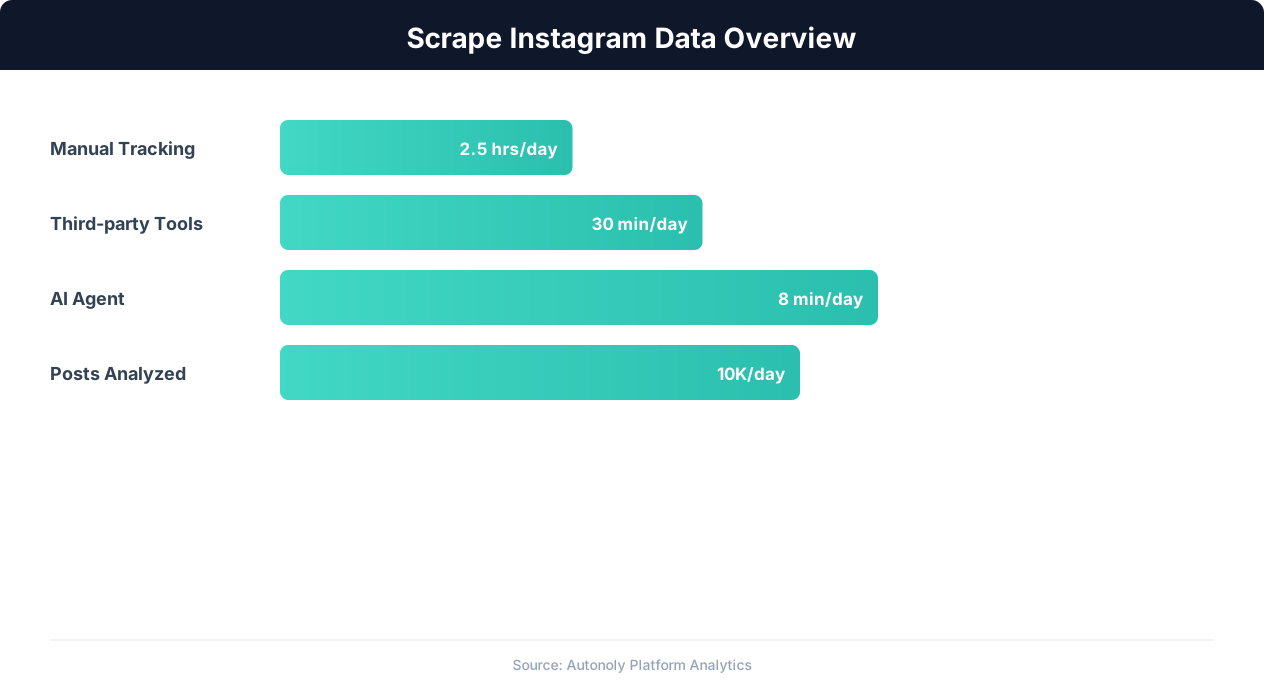
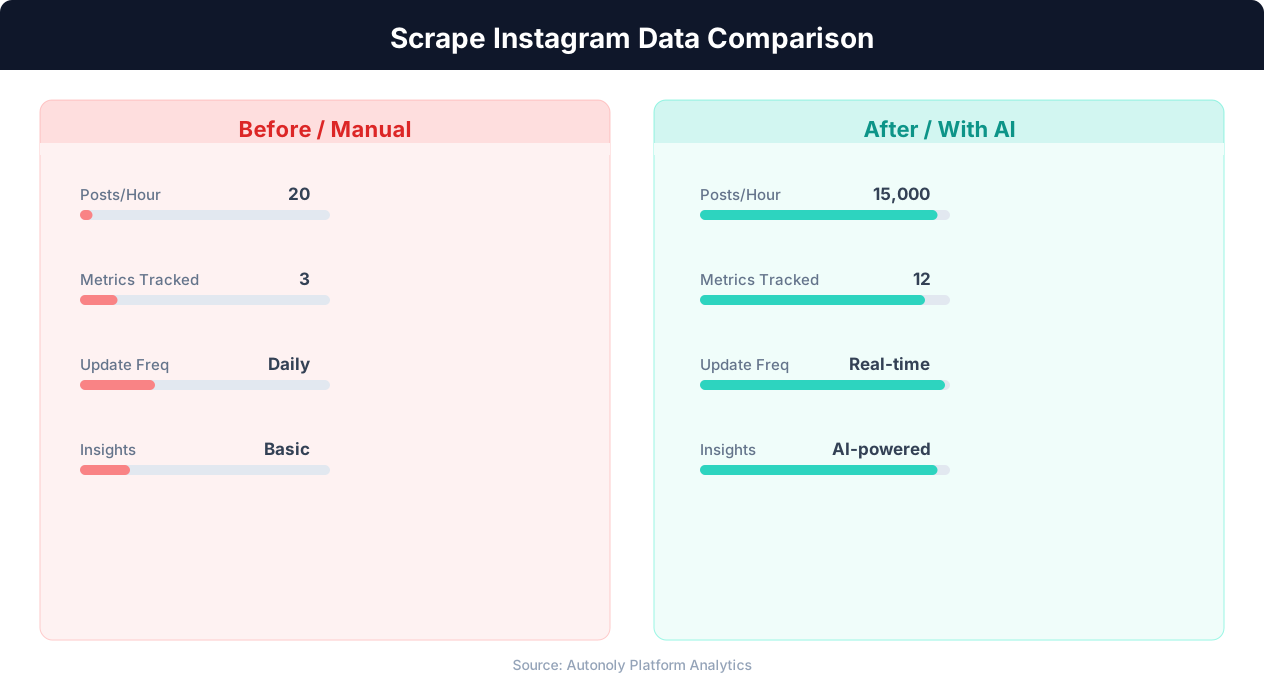
Manually browsing Instagram profiles and copying data into a spreadsheet is feasible for 20-30 profiles. But influencer databases need thousands of profiles, competitive analysis requires tracking hundreds of brands, and lead generation campaigns target entire market segments. At this scale, manual research takes weeks and produces stale data by the time it is complete. Automated extraction collects the same data in hours and can be refreshed on a recurring schedule.
What Instagram Data Can You Extract?
Instagram profiles and content contain structured data that can be extracted and organized into spreadsheets for analysis. Understanding what is available — and what is most useful for your specific goal — helps you design focused extraction workflows.
Profile-Level Data
Every public Instagram profile exposes these data points:
| Field | Description | Business Use |
|---|---|---|
| Username | The @handle | Unique identifier, outreach targeting |
| Full Name | Display name on the profile | Personalized outreach |
| Bio | 150-character profile description | Business type, email discovery, value proposition |
| Website URL | Link in bio | Website analysis, email discovery |
| Follower Count | Number of followers | Reach estimation, influencer tier classification |
| Following Count | Number of accounts followed | Follower/following ratio analysis |
| Post Count | Total number of posts | Activity level assessment |
| Profile Picture URL | Link to profile image | Visual verification |
| Is Business Account | Whether the account is a business profile | B2B lead filtering |
| Category | Business category (for business accounts) | Industry classification |
| Contact Info | Email, phone, address (if public) | Direct outreach |
Email Discovery From Instagram
Email addresses are the most valuable extraction target for outreach campaigns. Instagram provides email data through several channels:
- Public business email: Business accounts can display a public email address through the "Email" contact button. This is the most reliable email source.
- Bio text: Many users include their email address directly in their bio text ("Contact: [email protected]" or "DM or email: [email protected]").
- Website scraping: Extract the website URL from the profile, then scrape the linked website for contact email addresses. This two-step approach often yields emails when the Instagram profile itself does not display one.
- Linktree and link-in-bio services: Many profiles link to a Linktree or similar service. Scraping these pages reveals additional contact information and social links.
Post and Content Data
Individual post data provides engagement analytics:
- Post type: Photo, video, carousel, or Reel
- Like count: Number of likes on the post
- Comment count: Number of comments
- Caption text: The post caption, including hashtags and mentions
- Post date: When the content was published
- Tagged accounts: Other accounts mentioned or tagged in the post
- Location tag: Geographic location if tagged
Follower and Following Lists
Extracting a profile's follower or following list provides a network view that is useful for audience analysis, lookalike targeting, and competitive intelligence. However, follower list extraction is significantly more time-consuming than profile scraping because each follower requires a separate data fetch, and Instagram's API limits make bulk follower extraction slow. For most lead generation use cases, profile-level data (followers count, engagement metrics) is sufficient without extracting the full follower list.
Engagement Metrics
Beyond raw follower counts, engagement metrics reveal account quality:
- Engagement rate: (Likes + Comments) / Followers. Industry average is 1-3%. Rates above 3% indicate a highly engaged audience. Rates below 1% suggest bought followers or disengaged audience.
- Posting frequency: Posts per week or month. Consistent posting indicates an active, maintained account.
- Comment quality: The substance of comments (real conversations vs. spam bots saying "Nice post!") indicates audience authenticity.
Technical Challenges of Scraping Instagram
Instagram is one of the most aggressively anti-scraping platforms on the internet. Meta (Instagram's parent company) invests heavily in bot detection and rate limiting to protect user data and maintain platform control. Understanding these challenges is essential for building reliable extraction workflows.
Authentication Requirements
Unlike many websites where public content is freely accessible, Instagram limits what unauthenticated visitors can see. Without logging in, you can view individual public profiles but with significant restrictions: limited post visibility, no access to follower lists, and frequent redirects to the login page. Most scraping approaches require an authenticated session to access meaningful amounts of data.
However, using personal Instagram accounts for scraping carries risk. Instagram actively monitors for automated behavior and may temporarily restrict or permanently ban accounts that trigger their bot detection systems. Best practice is to use dedicated accounts (not your personal or business account) and to keep automated activity within conservative rate limits.
Rate Limiting
Instagram enforces strict rate limits on all types of data access:
- Profile views: Viewing too many profiles in a short period triggers temporary blocks (typically 24-48 hours)
- Search queries: Repeated searches trigger CAPTCHA challenges or search functionality blocks
- Follower list access: Scrolling through follower lists is rate-limited to prevent bulk extraction
- API calls: Instagram's undocumented internal API endpoints have aggressive rate limiting that varies by endpoint and account age
Effective scraping requires staying well within these limits. A conservative approach — 2-3 second delays between actions, no more than 100-200 profiles per hour, and session rotation — provides sustainable access without triggering blocks.
Dynamic Content and JavaScript Rendering
Instagram is a single-page application (SPA) built with React. All content loads dynamically through JavaScript API calls, making traditional HTTP-based scraping ineffective. You need a real browser that executes JavaScript, renders the page, and interacts with dynamic elements (infinite scroll, expandable sections, modal dialogs).
Anti-Bot Detection
Instagram employs sophisticated bot detection including:
- Browser fingerprinting: Checking for automation markers in the browser environment
- Behavioral analysis: Monitoring mouse movements, scroll patterns, and click timing for bot-like regularity
- Challenge screens: Presenting verification challenges when suspicious activity is detected
- Account-level tracking: Correlating activity patterns across the logged-in account's full session history
Autonoly's browser automation operates as a real Chromium browser with authentic fingerprints and human-like interaction patterns, which provides the most reliable foundation for Instagram data collection. For additional anti-detection strategies, see our guide on bypassing anti-bot detection.
Step-by-Step: Scraping Instagram Data with Autonoly
This walkthrough demonstrates extracting Instagram profile data for influencer marketing research. The same approach adapts to any Instagram data collection use case.
Step 1: Define Your Target Criteria
Before scraping, define what profiles you want to find. For influencer marketing, typical criteria include:
- Follower count range (e.g., 10K-100K for micro-influencers)
- Content niche (fitness, cooking, tech, fashion)
- Geographic location
- Engagement rate threshold
- Business account vs. personal account
Write these criteria down — they will guide your search strategy and help the AI agent target the right profiles.
Step 2: Create a Scraping Workflow
Create a new workflow in Autonoly and describe your goal to the AI Agent:
"I need to find Instagram influencers in the fitness niche with 10K-100K followers. Search Instagram for fitness-related hashtags like #fitnessmotivation, #gymlife, and #healthylifestyle. For each profile that posts with these hashtags, extract their username, full name, bio, website, follower count, following count, post count, and email if visible. Collect at least 200 unique profiles."
The agent plans a search strategy using your specified hashtags and criteria.
Step 3: Search and Discover Profiles
The agent navigates Instagram through a live browser, searches for your target hashtags, and identifies profiles from the top posts and recent posts for each hashtag. For each discovered profile, the agent visits the profile page and checks whether the follower count falls within your specified range before extracting data.
This hashtag-based discovery approach surfaces active, relevant profiles rather than scraping random accounts. Profiles that post with niche hashtags are more likely to be genuine participants in that niche.
Step 4: Extract Profile Data
For each qualifying profile, the agent extracts the full set of profile data: username, display name, bio, website URL, follower count, following count, post count, business category (if a business account), and any visible contact information. The agent also calculates engagement rate from the most recent posts (average likes and comments relative to follower count).
Step 5: Email Discovery
For profiles where a direct email is not visible on the Instagram profile, the agent attempts email discovery through secondary sources:
- Check the bio text for email patterns
- Visit the profile's linked website and look for contact information
- Check Linktree or similar link-in-bio pages for email addresses
This multi-step approach increases the email discovery rate significantly beyond what Instagram profiles alone provide.
Step 6: Export to Google Sheets
The agent writes all extracted data to a Google Sheet with properly formatted columns. Each row represents one profile, and the sheet includes calculated fields like engagement rate and a flag for whether an email was found. The sheet is immediately ready for filtering, sorting, and outreach prioritization.
Step 7: Filter and Qualify
With the raw data in Google Sheets, apply filters to narrow your influencer list:
- Filter by engagement rate > 3% to find highly engaged audiences
- Filter for profiles with website URLs (indicates a more professional creator)
- Filter for profiles where an email was found (ready for outreach)
- Sort by follower count to prioritize by reach
The filtered list becomes your outreach target list for influencer marketing campaigns.
Advanced Search and Discovery Strategies
Finding the right Instagram profiles requires strategic search approaches that go beyond simple keyword searches. These advanced strategies maximize the quality and relevance of discovered profiles.
Hashtag-Based Discovery
Hashtags are the primary discovery mechanism on Instagram. Each niche has a hierarchy of hashtags from broad to specific:
- Broad hashtags (1M+ posts): #fitness, #food, #travel — high volume but low specificity. Useful for casting a wide net but produces many irrelevant results.
- Medium hashtags (100K-1M posts): #mealprep, #veganrecipes, #homeworkout — good balance of volume and relevance. Most useful for discovering active niche creators.
- Niche hashtags (10K-100K posts): #veganmealprep, #homeworkoutideas, #glutenfreerecipes — highly specific. Profiles using these are deeply engaged in the niche.
- Branded hashtags: #nikerunning, #peloton, #wholefoods — identify users who engage with specific brands, useful for competitor audience analysis.
For comprehensive discovery, search across all tiers. Start with medium and niche hashtags for relevance, then supplement with broad hashtags for coverage.
Location-Based Discovery
Instagram posts can be tagged with geographic locations. For location-specific campaigns (local businesses, regional influencers, city-specific marketing), explore posts tagged at relevant locations: specific cities, neighborhoods, venues, or landmarks. This surfaces locally active profiles that may not appear in hashtag searches.
💡 Key Insight
Instagram has over 2 billion monthly active users, making it a critical data source for brand and influencer analytics.
Competitor Follower Mining
Your competitors' followers are already interested in your industry. By analyzing the followers of competitor accounts, you can identify potential customers, partners, or influencers. While extracting full follower lists is rate-limited, you can sample followers by viewing the follower list and extracting profiles that match your criteria.
A more efficient approach: identify accounts that engage (like and comment) on competitor posts. Engagers are more active and interested than passive followers, making them higher-quality prospects.
Mentioned and Tagged Account Discovery
When users tag other accounts in posts and comments, those tags represent real relationships and recommendations. Scraping tagged accounts from posts in your niche reveals networks of related profiles. For influencer marketing, accounts frequently tagged by other influencers are often influencers themselves. For B2B lead generation, accounts tagged in business-related posts may be partners, vendors, or potential clients.
Profile-Chain Discovery
Start with a known seed profile (a confirmed influencer or business in your niche) and discover related profiles through:
- Similar accounts: Instagram's "Suggested for You" section on each profile recommends similar accounts
- Tagged collaborations: Other accounts tagged in the seed profile's posts are often in the same niche
- Mutual followers: Accounts followed by multiple seed profiles are likely relevant to the niche
This chain discovery approach is particularly effective for building comprehensive databases within narrow niches where hashtag-based discovery alone does not surface enough profiles.
Analyzing Engagement and Qualifying Leads
Raw follower counts are misleading. An account with 500K followers and 0.1% engagement rate reaches fewer people effectively than an account with 50K followers and 5% engagement. Engagement analysis transforms raw Instagram data into qualified, prioritized prospect lists.
Calculating Engagement Rate
The standard engagement rate formula for Instagram is:
Engagement Rate = (Average Likes + Average Comments per Post) / Follower Count x 100
Calculate this from the most recent 10-12 posts to get a current, representative rate. Exclude outlier posts (viral content or clearly promoted posts) that would skew the average.
Engagement Rate Benchmarks
| Follower Range | Average ER | Good ER | Excellent ER |
|---|---|---|---|
| 1K - 10K (nano) | 3-5% | 5-8% | 8%+ |
| 10K - 100K (micro) | 1.5-3% | 3-5% | 5%+ |
| 100K - 500K (mid) | 1-2% | 2-3% | 3%+ |
| 500K+ (macro) | 0.5-1.5% | 1.5-2.5% | 2.5%+ |
Engagement rates naturally decrease as follower counts increase. A 50K-follower account with 4% engagement is performing exceptionally well, while a 1M-follower account with the same rate would be extraordinary.
Detecting Fake Followers
Fake followers are a pervasive problem on Instagram. Signs of inflated follower counts include:
- Very low engagement rate: Follower-to-engagement ratios below the benchmarks above, especially for accounts with 10K+ followers
- Comment quality: Generic comments like "Great post!" "Love this!" or emoji-only comments from accounts with suspicious profiles suggest bot engagement
- Follower/following ratio: Accounts with very high following counts relative to followers (1:1 ratio) may have used follow-for-follow tactics to inflate numbers
- Sudden follower spikes: While you cannot see historical follower data from a single scrape, monitoring follower counts over time reveals unnatural growth patterns
Lead Scoring for Outreach
Combine Instagram metrics into a lead quality score for outreach prioritization:
- +3 points: Email found (direct contact possible)
- +2 points: Website URL present (professional presence)
- +2 points: Engagement rate above niche average
- +1 point: Business account (indicates professional use)
- +1 point: Active posting (3+ posts per week)
- -2 points: Engagement rate below 0.5% (possible fake followers)
- -1 point: No bio or generic bio (low effort profile)
Sort your extracted data by lead score and focus outreach on the highest-scoring profiles first. This ensures your sales or marketing team spends time on the most promising prospects.
Audience Overlap Analysis
For influencer marketing, understanding audience overlap between influencers prevents wasted reach. If two influencers have 80% audience overlap, partnering with both gives you only 20% incremental reach from the second partnership. While precise audience overlap requires Instagram API access, proxy signals include mutual followers (accounts that follow both influencers) and geographic alignment (influencers in the same city likely share more followers than those in different countries).
Compliance, Ethics, and Instagram's Terms of Service
Instagram data scraping operates in a complex legal and ethical landscape. Meta's platform policies, privacy regulations, and ethical considerations all constrain how Instagram data should be collected and used.
Instagram's Terms of Service
Instagram's Terms of Use explicitly prohibit collecting data through automated means without Meta's written permission. The relevant section states: "You can't attempt to create accounts or access or collect information in unauthorized ways. This includes creating accounts or collecting information in an automated way without our express permission."
Meta enforces this policy through technical measures (bot detection, rate limiting, account bans) and occasional legal action against scraping companies. In practice, Meta focuses enforcement on large-scale commercial data aggregators rather than individual businesses collecting data for their own outreach purposes, but the legal risk exists for any automated data collection.
Privacy Regulations
Instagram profile data includes personal information subject to privacy laws:
- GDPR (EU/UK): Instagram profile data of EU residents is personal data under GDPR. Collection requires a lawful basis (legitimate interest is the most applicable for B2B outreach). You must honor data access and deletion requests, and you should limit data retention to what is necessary.
- CCPA (California): Publicly available information has an exemption under CCPA, but this exemption is narrow and contested. Instagram data may or may not qualify depending on interpretation.
- CAN-SPAM (US): If you use extracted email addresses for marketing, CAN-SPAM requires identifying emails as advertising, including a physical address, and providing an opt-out mechanism.
💡 Key Insight
Brands using automated Instagram analytics identify trending content 5x faster and improve engagement rates by 35%.
Ethical Considerations
Beyond legal requirements, ethical data collection practices protect your reputation and build sustainable business relationships:
- Respect privacy settings: Only scrape public profiles. Do not attempt to access private accounts, private posts, or direct messages.
- Limit data collection: Collect only the data you actually need. If you only need emails for outreach, do not also scrape photos, post content, and comment text.
- Use data for its intended purpose: Data collected for influencer marketing should not be repurposed for audience targeting, profiling, or resale without consent.
- Provide value in outreach: When using scraped data for outreach, offer genuine value. Personalized, relevant outreach based on profile analysis is welcomed; generic spam based on bulk data collection is not.
- Honor opt-outs: If someone asks to be removed from your contact list, remove them immediately and permanently.
Risk Mitigation
To minimize legal and platform risk:
- Use conservative rate limits. Stay well below Instagram's detection thresholds. Slow, steady collection is better than aggressive bursts.
- Do not scrape private data. Only access information visible to any public viewer.
- Document your compliance measures. Record your scraping policies, rate limits, data retention periods, and opt-out handling procedures.
- Consider the official API. Instagram's Graph API provides authorized access to business account data, post insights, and hashtag search. The API has significant limitations (requires business account approval, limited data scope), but it eliminates platform risk entirely.
- Do not resell data. Using scraped data for your own business outreach is very different from aggregating and selling Instagram data commercially.
For a broader overview of web scraping legality, see our comprehensive web scraping best practices guide.
Building an Automated Instagram-to-Outreach Pipeline
The ultimate goal of Instagram data extraction is not just having a spreadsheet of profiles — it is converting that data into business outcomes. An automated pipeline that flows from Instagram discovery through qualification to personalized outreach maximizes the ROI of your data collection efforts.
The Complete Pipeline
A mature Instagram lead generation pipeline has these stages:
- Discovery: Scrape Instagram profiles based on hashtags, locations, and niche criteria. Output: raw profile database in Google Sheets.
- Enrichment: For each profile, visit the linked website to extract additional contact information (email, phone, team names). Cross-reference with LinkedIn for B2B contacts. Output: enriched profile database.
- Qualification: Calculate engagement rates, detect fake followers, and apply lead scoring. Filter to profiles that meet your minimum quality criteria. Output: qualified lead list.
- Segmentation: Group qualified leads by category (nano-influencer, micro-influencer, business account), location, content niche, and lead score. Output: segmented outreach lists.
- Outreach: Send personalized emails or DMs to each segment with messaging tailored to their profile characteristics. Reference specific posts, content themes, or engagement metrics to demonstrate genuine interest.
- Tracking: Monitor response rates by segment to optimize your discovery criteria and outreach messaging for future campaigns.
Personalization at Scale
The data extracted from Instagram enables personalization that generic outreach cannot match. Instead of "Hi, I found your profile on Instagram," you can write:
"Hi Sarah, I noticed your workout content has been getting great engagement lately — your reel about home dumbbell exercises had over 5,000 likes. We work with fitness creators in your follower range to..."
This level of personalization is only possible when your data includes engagement metrics, content themes, and recent post performance — all extractable from public Instagram profiles.
Automating the Pipeline with Autonoly
Each stage of the pipeline can be automated as a connected workflow in Autonoly's visual workflow builder:
- Stage 1 (Discovery): Scheduled weekly Instagram scraping workflow that searches target hashtags and extracts qualifying profiles
- Stage 2 (Enrichment): Browser automation workflow that visits each profile's linked website for email extraction
- Stage 3 (Qualification): Data processing workflow that calculates engagement rates and applies lead scoring formulas
- Stage 4 (Output): Integration workflows that push qualified leads to your CRM or email outreach tool
The entire pipeline runs on a weekly schedule, continuously feeding fresh, qualified Instagram leads into your sales pipeline. Combined with automated lead generation workflows, this creates a scalable prospecting machine that requires minimal ongoing maintenance.
Measuring Pipeline ROI
Track these metrics to measure your Instagram scraping pipeline's effectiveness:
- Profiles scraped per run: Total extraction volume
- Email discovery rate: Percentage of profiles where an email was found (target: 30-50%)
- Qualification rate: Percentage of scraped profiles that meet quality criteria (target: 20-40%)
- Outreach response rate: Percentage of contacted leads that respond (target: 5-15% for cold outreach)
- Conversion rate: Percentage of responses that convert to partnerships or sales
- Cost per qualified lead: Total pipeline cost divided by qualified leads generated
Optimizing each stage of the pipeline — better discovery criteria, higher email find rates, more effective outreach messaging — compounds into significantly better overall ROI over time.